
Sheet 06 of 15
Contour Flange: a Channel from an Open Sketch
In 5 minutes you'll draw an open profile, turn it into a bent channel with one Contour Flange, and learn which side of your lines the sheet goes.
- Part
- Contour Flange
- Rule
- Steel 2mm
- Sheet
- t 2 · R 2 · K 0.4
- Time
- 5 min
- Status
- Open
OP 10Watch
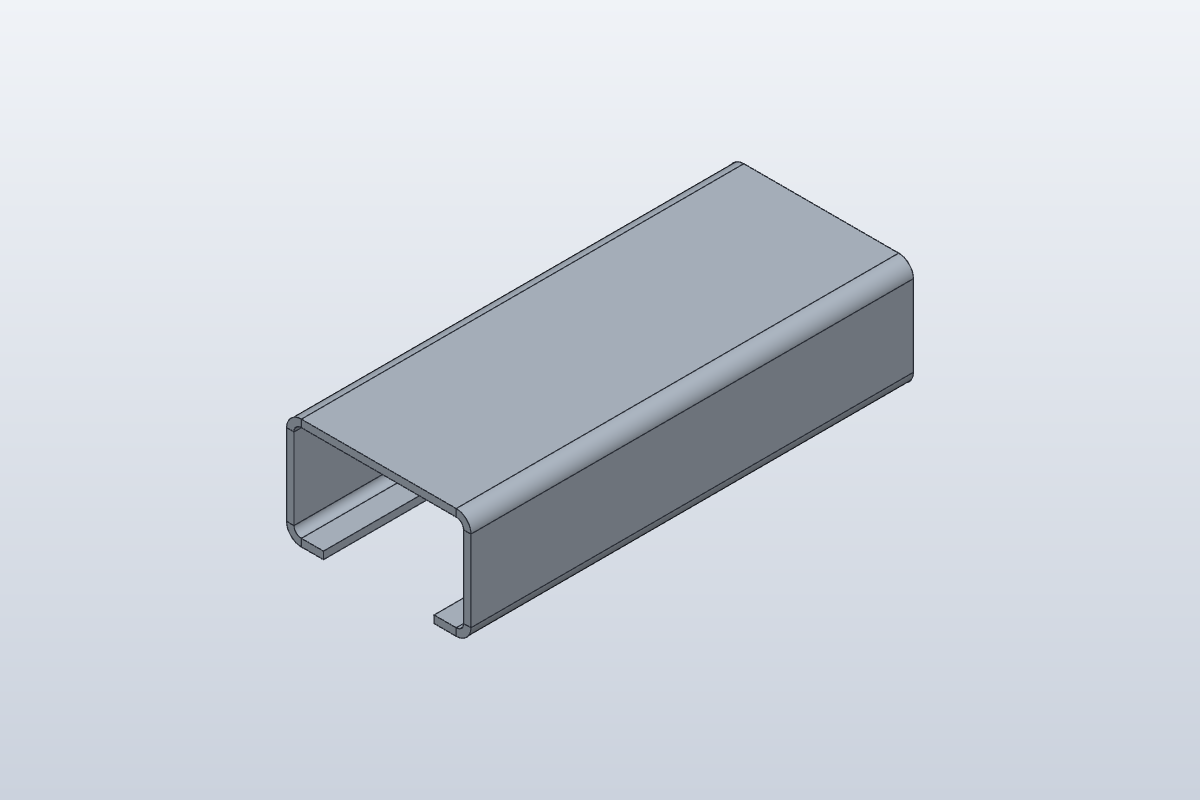
Video in productionBuild along with the steps in OP 30 meanwhile.
OP 20Turn the part
Drag to turn, scroll or pinch to zoom. Flat shows the blank before it is bent: the same sheet, the same frame.
The model shows part A, for illustration. Your part has its own sizes: build it from the drawing in OP 30.
OP 30Build it in SolidCraft
Part A of 8. Every learner gets a part with its own sizes, so the values you check below are yours to find.
A new part has new sizes. It clears this sheet's checks and ticked steps; your quiz answers stay.
The picture shows part A, for illustration. Build your part from the drawing and the sizes listed here.
- Rule
- Steel 2mm
- Thickness
- 2 mm
- Bend radius
- 2 mm
- K-factor
- 0.4
As typed in this exercise
- Sketch Profile on XZ: line (10, 30) – (0, 30) – (0, 0) – (50, 0) – (50, 30) – (40, 30)
- Flange: distance 120, flip
Your task
Build this lipped channel from the drawing above.
- The rule from the drawing's notes.
- New this time: a sketch on XZ with one open chain of five lines, the channel's cross-section (the points are listed under the drawing). Don't close it.
- Flange on the five lines: Type says Contour; Distance is the channel's length. The sizes are outside sizes, so the sheet must lie inside the lines: use Flip until the preview shows that.
- Flat Pattern: read the Flat size's first number and the Bends.
- Change only Flip, and read the Flat size again.
What to write down
- Box 1: The first number of Flat size with the sheet inside the lines.
- Box 2: The number of bends.
- Box 3: The first number of Flat size with the sheet outside the lines.
The second number of the flat size is the Distance, 120 mm, both times. Type the values below and press Check.
OP 40Inspect
Enter what SolidCraft shows you. Each value is checked against SolidCraft's own result, within the tolerance shown. Nothing you type leaves this page.
Stuck? Compare with the finished part
This opens once you've checked every box at least once: try it yourself first.
Open it in SolidCraft (File › Open) next to yours and compare the timeline, the rule and each feature's sizes: the first one that differs is where yours went wrong.
exercise · Steel 2mm · t 2 · R 2 · K 0.4 · all dimensions in mm, from the blank's left and bottom edgesFlat blank 115.593 × 120.000 mm · 4 bends
| Bend | Angle | Dir. | R mm | Length mm | Allowance mm |
|---|---|---|---|---|---|
| 1 | 90° | up | 2 | 120 | 4.398 |
| 2 | 90° | up | 2 | 120 | 4.398 |
| 3 | 90° | up | 2 | 120 | 4.398 |
| 4 | 90° | up | 2 | 120 | 4.398 |
exercise-noflip · Steel 2mm · t 2 · R 2 · K 0.4 · all dimensions in mm, from the blank's left and bottom edgesFlat blank 131.593 × 120.000 mm · 4 bends
| Bend | Angle | Dir. | R mm | Length mm | Allowance mm |
|---|---|---|---|---|---|
| 1 | 90° | down | 2 | 120 | 4.398 |
| 2 | 90° | down | 2 | 120 | 4.398 |
| 3 | 90° | down | 2 | 120 | 4.398 |
| 4 | 90° | down | 2 | 120 | 4.398 |
OP 50Quiz
Q1What kind of sketch does a contour flange use?
A contour flange follows an open chain of lines; a closed profile makes a base flange instead.
Q2What does Distance set in a contour flange?
Distance is how far the profile is carried out of its sketch plane. Thickness and radius come from the rule.
Q3You tick Flip on a contour flange. What changes?
The lines are one face of the sheet; Flip puts the thickness on their other side, which changes the part's size and its flat length.
Every value is within tolerance. This sheet is done.
Sheet 07: Path Flange