
Sheet 07 of 15
Path Flange: Draw the Shape, Get the Bends
In 5 minutes you'll sketch a hook's shape as three lines and turn it into three bends on a shelf's edge with one Path Flange, then change the sketch and watch the part follow.
- Part
- Path Flange
- Rule
- Steel 1.5mm
- Sheet
- t 1.5 · R 1.5 · K 0.4
- Time
- 5 min
- Status
- Open
OP 10Watch
Video in productionBuild along with the steps in OP 30 meanwhile.
OP 20Turn the part
Drag to turn, scroll or pinch to zoom. Flat shows the blank before it is bent: the same sheet, the same frame.
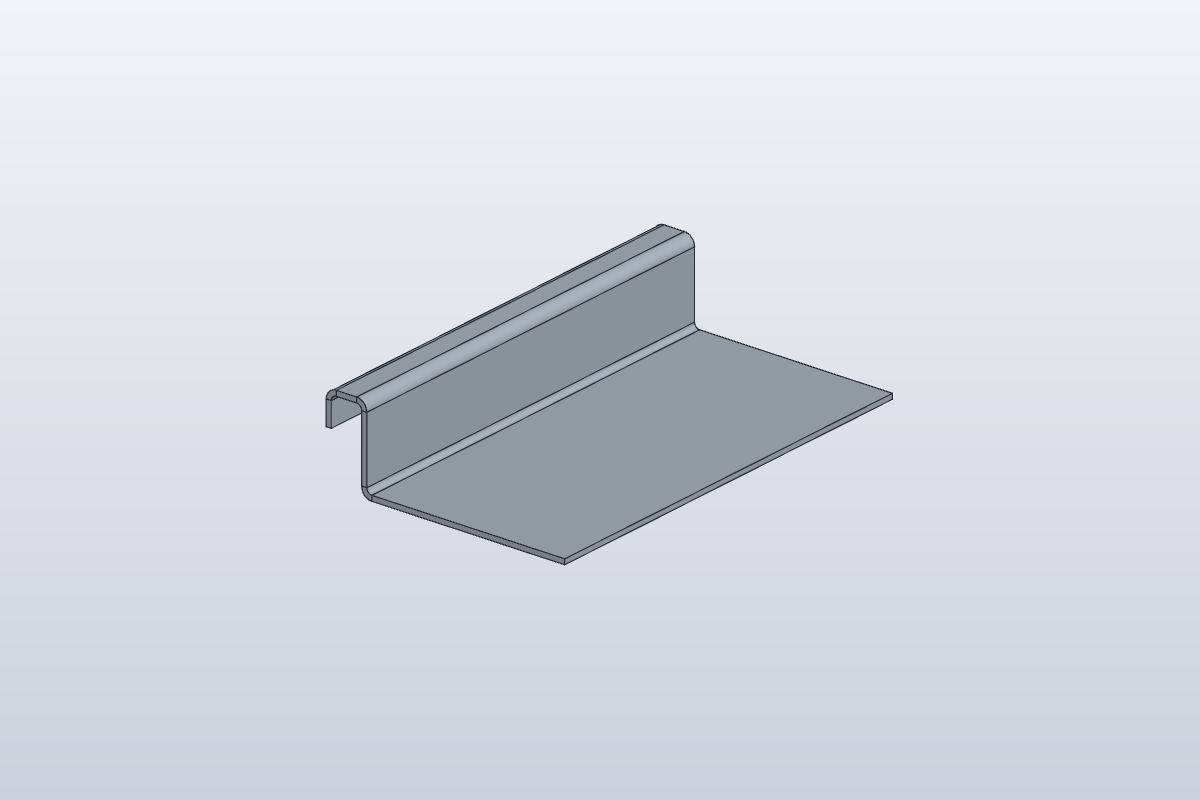
The model shows part A, for illustration. Your part has its own sizes: build it from the drawing in OP 30.
OP 30Build it in SolidCraft
Part A of 8. Every learner gets a part with its own sizes, so the values you check below are yours to find.
A new part has new sizes. It clears this sheet's checks and ticked steps; your quiz answers stay.
The picture shows part A, for illustration. Build your part from the drawing and the sizes listed here.
- Rule
- Steel 1.5mm
- Thickness
- 1.5 mm
- Bend radius
- 1.5 mm
- K-factor
- 0.4
As typed in this exercise
- Sketch Base on XY: rectangle (0, 0) to (120, 60)
- Sketch Path on YZ: line (0, 0) – (0, 25) – (-12, 25) – (-12, 15)
Your task
Build this hook-on shelf from the drawing above. It hangs over a rail by its hook.
- The rule from the drawing's notes, then the shelf: its rectangle on XY at the origin, and Flange.
- New this time: a sketch on the YZ plane with an open chain of three lines from the origin (the front edge's bottom corner): up, away from the shelf, then down, as the drawing's right view shows the hook. Give them their sizes with Sketch Dimension.
- Sheet Metal tab › Path: Edge the shelf's front edge, Path the three lines. OK.
- Flat Pattern: read A, the second number of the Flat size, and the Bends.
- Edit the Path sketch: make the first line 10 mm longer, finish the sketch, and read A again.
What to write down
- Box 1: A, the flat length across the bends (the first number of Flat size is 120 mm, along the edge).
- Box 2: The number of bends.
- Box 3: A again, with the wall 35 mm.
Type them below and press Check.
OP 40Inspect
Enter what SolidCraft shows you. Each value is checked against SolidCraft's own result, within the tolerance shown. Nothing you type leaves this page.
Stuck? Compare with the finished part
This opens once you've checked every box at least once: try it yourself first.
Open it in SolidCraft (File › Open) next to yours and compare the timeline, the rule and each feature's sizes: the first one that differs is where yours went wrong.
exercise · Steel 1.5mm · t 1.5 · R 1.5 · K 0.4 · all dimensions in mm, from the blank's left and bottom edgesFlat blank 120.000 × 98.896 mm · 3 bends
| Bend | Angle | Dir. | R mm | Length mm | Allowance mm |
|---|---|---|---|---|---|
| 1 | 90° | up | 1.5 | 120 | 3.299 |
| 2 | 90° | down | 1.5 | 120 | 3.299 |
| 3 | 90° | down | 1.5 | 120 | 3.299 |
exercise-tall · Steel 1.5mm · t 1.5 · R 1.5 · K 0.4 · all dimensions in mm, from the blank's left and bottom edgesFlat blank 120.000 × 108.896 mm · 3 bends
| Bend | Angle | Dir. | R mm | Length mm | Allowance mm |
|---|---|---|---|---|---|
| 1 | 90° | up | 1.5 | 120 | 3.299 |
| 2 | 90° | down | 1.5 | 120 | 3.299 |
| 3 | 90° | down | 1.5 | 120 | 3.299 |
OP 50Quiz
Q1What does each line of a Path Flange's sketch become?
Each line is one flange as long as the line, and each corner between lines is one bend. The sheet's thickness and bend radius come from the rule.
Q2Where do you draw a Path Flange's sketch?
The path is the flange's cross-section, so it's drawn on a plane square to the edge, starting where the sheet's edge is.
Q3You make the first line of the path 10 mm longer. What happens to the part?
The Path Flange follows its sketch: change a line and the flange changes with it, and the flat pattern grows by the same 10 mm.
Every value is within tolerance. This sheet is done.
Sheet 08: Hems