
Electronics Tray: Flanges on Flanges
In 6 minutes you'll fold the walls of an electronics tray, then fold a lip off the top of every wall with a second Flange, and see SolidCraft mitre the lips where they meet.
- Lesson
- Sheet 01 of 05
- Part
- Flanges on Flanges
- Rule
- Steel 1.5mm
- Sheet
- t 1.5 · R 1.5 · K 0.4
- Time
- 6 min
- Status
- Open
Watch
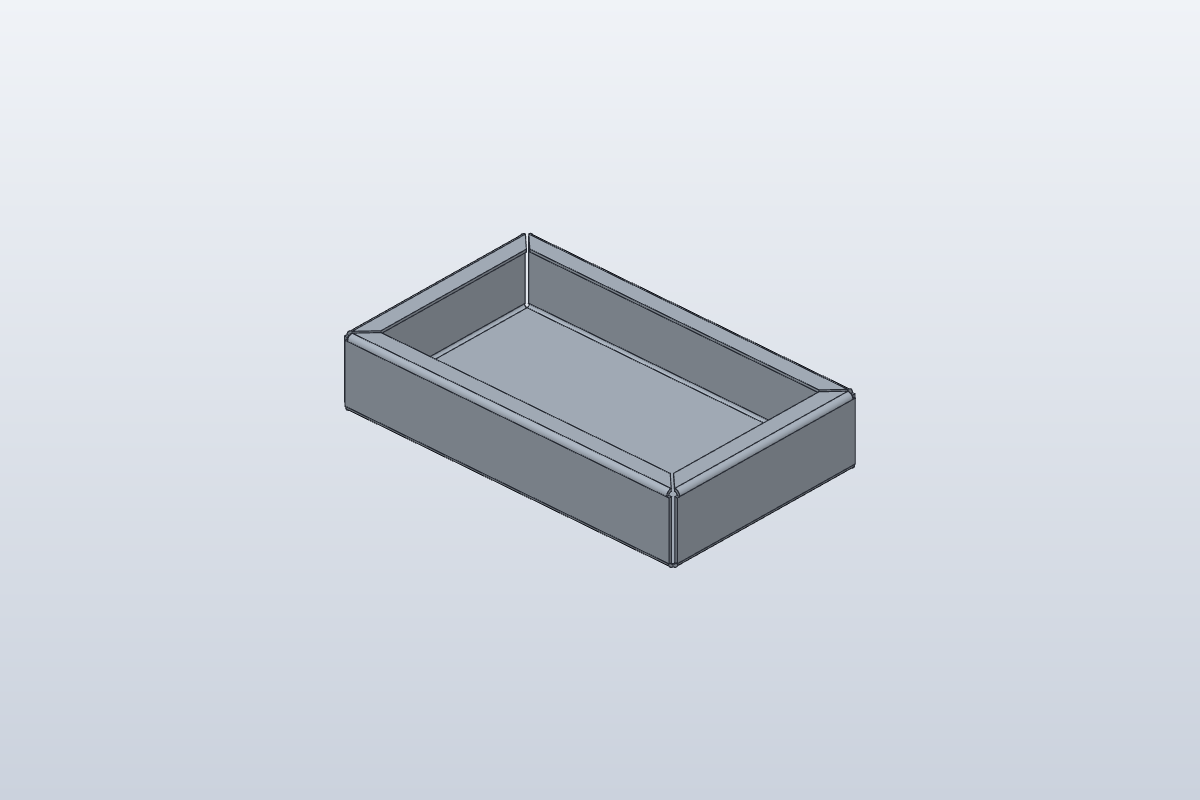
Video in productionBuild along with the steps below meanwhile.
Turn the part
Drag to turn, scroll or pinch to zoom. Flat shows the blank before it is bent: the same sheet, the same frame.
The model shows part A, for illustration. Your part has its own sizes: build it from the drawing below.
Build it in SolidCraft
Part A of 8. Every learner gets a part with its own sizes, so the values you check below are yours to find.
A new part has new sizes. It clears this sheet's checks and ticked steps; your quiz answers stay.
The picture shows part A, for illustration. Build your part from the drawing and the sizes listed here.
- Rule
- Steel 1.5mm
- Thickness
- 1.5 mm
- Bend radius
- 1.5 mm
- K-factor
- 0.4
Your task
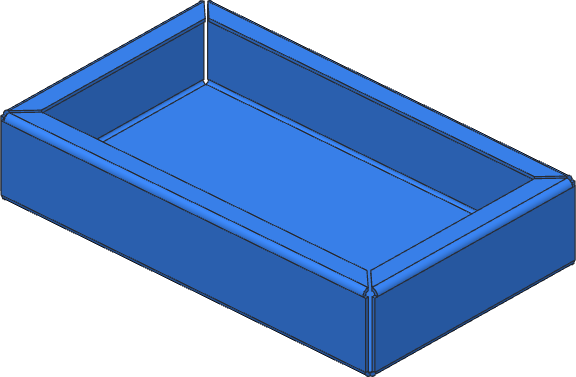
Build this electronics tray from the drawing above. The lips stiffen its top edge and give a lid something to sit on.
- The rule from the drawing's notes, then the base: its rectangle on XY at the origin, and Flange.
- Flange again on the base's four edges: the walls, all four in one Flange.
- New this time: Flange a third time, and pick the top edges of the four walls. Height the lip, and Flip so the lips fold in over the tray. OK.
- Flat Pattern: read the Flat size and the Bends.
What to write down
- Box 1: The Flat size, first number.
- Box 2: The Flat size, second number.
- Box 3: The number of bends.
Type them below and press Check.
Check your numbers
Enter what SolidCraft shows you. Each value is checked against SolidCraft's own result, within the tolerance shown. Nothing you type leaves this page.
Stuck? Compare with the finished part
This opens once you've checked every box at least once: try it yourself first.
Open it in SolidCraft (File › Open) next to yours and compare the timeline, the rule and each feature's sizes: the first one that differs is where yours went wrong.
exercise · Steel 1.5mm · t 1.5 · R 1.5 · K 0.4 · all dimensions in mm, from the blank's left and bottom edgesFlat blank 293.195 × 213.195 mm · 8 bends
| Bend | Angle | Dir. | R mm | Length mm | Allowance mm |
|---|---|---|---|---|---|
| 1 | 90° | up | 1.5 | 194 | 3.299 |
| 2 | 90° | up | 1.5 | 114 | 3.299 |
| 3 | 90° | up | 1.5 | 194 | 3.299 |
| 4 | 90° | up | 1.5 | 114 | 3.299 |
| 5 | 90° | up | 1.5 | 191.88 | 3.299 |
| 6 | 90° | up | 1.5 | 111.88 | 3.299 |
| 7 | 90° | up | 1.5 | 191.88 | 3.299 |
| 8 | 90° | up | 1.5 | 111.88 | 3.299 |
exercise-nolips · Steel 1.5mm · t 1.5 · R 1.5 · K 0.4 · all dimensions in mm, from the blank's left and bottom edgesFlat blank 274.597 × 194.597 mm · 4 bends
| Bend | Angle | Dir. | R mm | Length mm | Allowance mm |
|---|---|---|---|---|---|
| 1 | 90° | up | 1.5 | 194 | 3.299 |
| 2 | 90° | up | 1.5 | 114 | 3.299 |
| 3 | 90° | up | 1.5 | 194 | 3.299 |
| 4 | 90° | up | 1.5 | 114 | 3.299 |
Quiz
Q1Which edges do you pick for the lips?
A flange can start on any straight edge of the sheet, a wall's edge too. Pick the four top edges of the walls and one Flange folds a lip off each.
Q2You fold the lips out instead of in. What happens to the flat size?
The lips use the same sheet either way. In or out only changes which way they fold, so check the part, not just the numbers.
Q3Why are the lips cut at an angle at the corners?
Two lips meet at each corner. SolidCraft mitres their ends, so they meet edge to edge with the rule's gap instead of overlapping.
Every value is within tolerance. This sheet is done.
Sheet 02: A Lid That Fits